The Emotional Beginning of a Musical Life
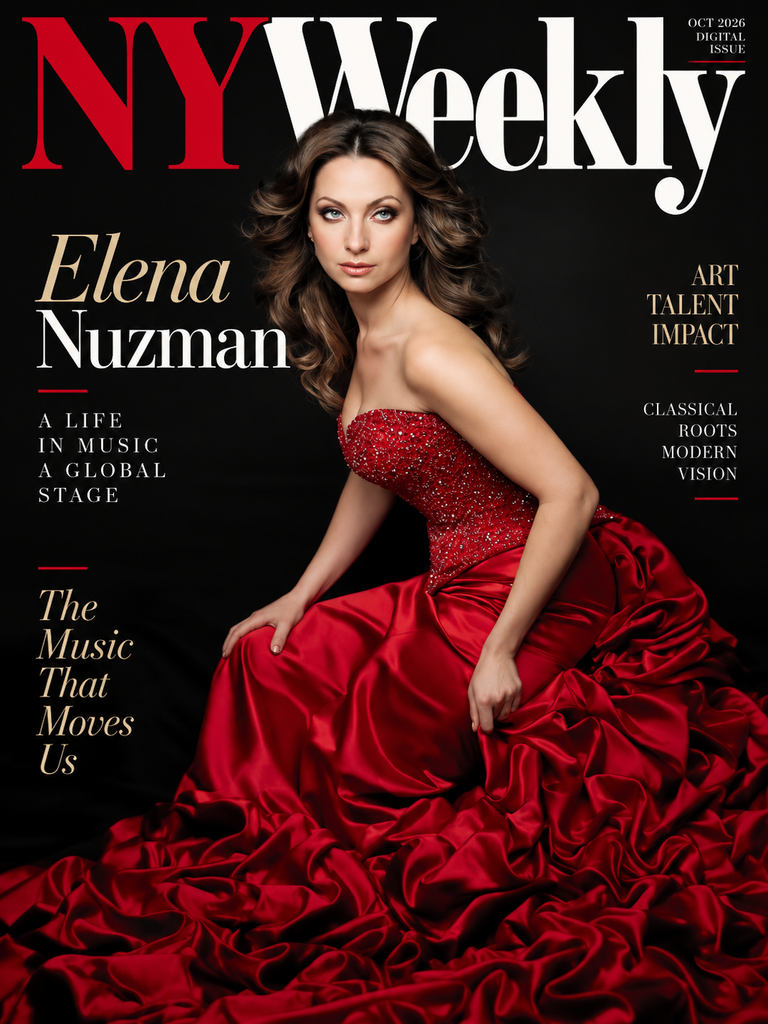
Some musicians are first remembered for a particular performance. Others are remembered for a distinctive sound. Elena Nuzman’s story begins somewhere more intimate: with memory.
At only two years old, she was already reproducing melodies by ear on the piano. Long before she understood the professional world of music, she was listening, remembering and translating what she heard into sound.
That early relationship with melody became the foundation of an extraordinary artistic life.
Born in Moldova into a family of professional musicians, Nuzman was surrounded by music from childhood. The environment gave her an early familiarity with instruments and performance, but her natural ability soon became apparent in its own right.
Music was not simply something around her.
It was something she absorbed.
Learning to Hear Before Learning to Perform
At seven, Nuzman entered a prestigious music Lyceum for gifted students and began the serious study of classical music.
Formal training changed the way she interacted with music. Instinct was joined by discipline. Listening became analysis. Natural musicality developed into technique.
The piano became the place where these elements came together.
Classical education taught her that a piece of music is more than a sequence of notes. Tempo can change the emotional character of a passage. A pause can create anticipation. A softer phrase can sometimes communicate more than a dramatic one.
Those lessons would eventually influence the way she approached singing and composition.
The emotional power of her later work can be traced, in part, to those early years of learning how music communicates without needing to explain itself.
A Life of Musical Movement
Nuzman’s development did not remain confined to Moldova.
Her musical journey took her through Russia, France, the United States, Israel and Canada before she continued her studies in Germany at the Robert Schumann University of Music in Düsseldorf.
There, she completed a master’s degree in concert piano.
Each stage added another layer to her musical perspective. International education and performance exposed her to different audiences and environments, while the discipline of classical study continued to anchor her artistic development.
Yet music remained personal.
No matter how sophisticated the stage or how demanding the repertoire, performance ultimately depends on communication between artist and listener.
That relationship would become even more important when Nuzman discovered singing.
When the Memory Found a Voice

Her transition into vocal performance began unexpectedly through a competition.
Nuzman entered a vocal competition and won first prize in the Rock-Pop category. The experience revealed a new dimension of her musicianship.
The piano had always allowed her to communicate through touch, timing and dynamics.
Now her own voice could carry the message.
Her four-octave range offered remarkable technical possibilities, but the emotional impact of singing came from something beyond range. A voice carries breath, vulnerability, personality and language. It allows an artist to place herself directly inside the emotional center of a song.
Nuzman found another way to tell stories.
Music That Reaches People
Her debut album, I Believe In You, represented an important step into the contemporary music landscape.
The album entered the German Newcomer Charts and remained in the Top 10 for several weeks. It brought together powerful vocal performances, emotional material and rock-pop influences.
Her interpretation of Whitesnake’s “Here I Go Again” became another significant part of her contemporary repertoire, with performances reaching large public audiences, including New Year’s Eve celebrations at Berlin’s Brandenburg Gate.
There is an emotional reason why performances like these matter.
Music can create a shared memory.
A listener may not remember every technical detail of a performance, but they may remember how a song made them feel, where they heard it, or who they were with at the time.
That emotional connection is central to Nuzman’s work.
Looking Back to Move Forward
Her project Liebestraum offered another perspective on musical memory.
The work drew inspiration from the Romantic tradition, bringing classical piano influences into a contemporary setting. Romantic music is deeply connected with emotion and atmosphere, making it particularly suited to an artist interested in the relationship between memory and melody.
Nuzman did not simply reproduce the past.
She interpreted it.
The title track surpassed four million views on YouTube and received the IMPALA Silver Award, demonstrating that the emotional language of classical music could still connect with contemporary audiences.
The success also reinforced a recurring idea in her career: music survives when its emotional meaning remains accessible.
The Composer’s Perspective
As Nuzman developed as a composer, her relationship with memory became even more creative.
A performer interprets a musical story.
A composer creates one.
Writing original material gives an artist the opportunity to transform personal experiences, influences and observations into something that can eventually belong to listeners.
That transformation is one of the most fascinating parts of music.
A melody begins as an idea inside one person and becomes a memory inside another.
Nuzman’s classical training gives her the technical vocabulary to construct those ideas, while her experience as a vocalist allows her to understand how words, melody and emotional delivery interact.
My Piano And I
In 2025, My Piano And I brought another deeply personal dimension to her work.
The album combines celebrated songs, new compositions and English versions of some of her works. Its title immediately points toward the central relationship of her life in music.
The piano has been present since childhood.
It witnessed her earliest musical discoveries. It accompanied her through formal education and international study. It remained important through her transformation into a vocalist and composer.
In that sense, the piano is more than an instrument.
It is part of her artistic memory.
The Sound of Experience
The older an artist becomes, the more experiences accumulate behind every performance.
Nuzman’s music carries the influence of childhood, classical education, international travel, vocal discovery, contemporary performance and composition.
These experiences do not necessarily need to be explained to an audience.
They can be heard.
A mature artist often performs differently from a young prodigy because experience changes the meaning of musical expression. Technical ability remains important, but emotional understanding becomes equally significant.
Nuzman’s career reflects that progression.
When Melody Becomes Something Personal

The story of Elena Nuzman is ultimately not only about genres, awards, albums or performances.
It is about what music remembers.
A melody can carry a childhood.
A piano can represent an entire education.
A song can preserve an emotion.
A performance can become a shared memory between an artist and thousands of listeners.
Nuzman has spent her life exploring that emotional territory.
From the child who reproduced melodies by ear to the concert pianist, vocalist and composer she is today, her relationship with music has continually developed while retaining its original instinct: listen carefully, feel deeply and translate that feeling into sound.
Her career demonstrates that music can travel across borders and generations without losing its most important quality.
Its ability to make us remember.